Apps / Blind Taste
The wine in your glass, explained.
Taste a wine blind and check your notes against an answer key built from the facts. Or just scan the label: Blind Taste explains the wine, from its grape, place and vintage to how it was made and why it tastes the way it does. Every fact shows where it came from.
For adults 21 and older.
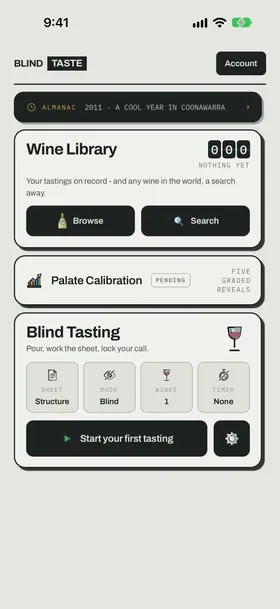
How a tasting works
The app withholds help until you commit. Your unaided call is the training.

- 1
Set up
Pick a sheet, blind or label-known, a flight of wines and an optional time limit.
- 2
Taste blind
One axis at a time: sweetness, acidity, tannin, body, alcohol, finish. Tap the word that fits.
- 3
Commit
Check for faults, then call grape, region and vintage. Locking is final.
- 4
Scan
Photograph the label or type the wine. The app identifies the bottle.
- 5
Debrief
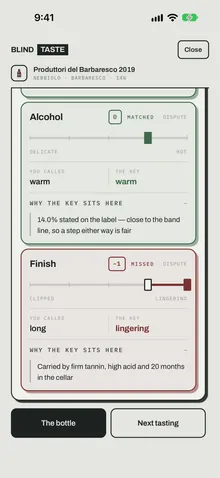
Your sheet against the key, axis by axis, with a one-sentence why for each.

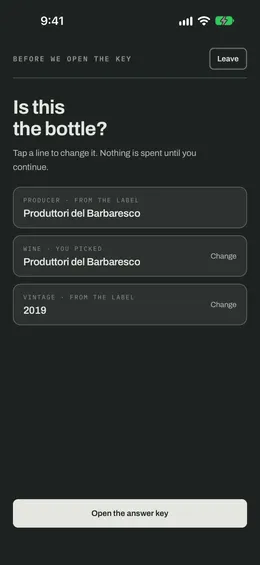
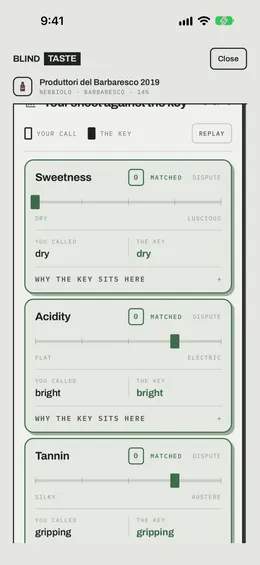
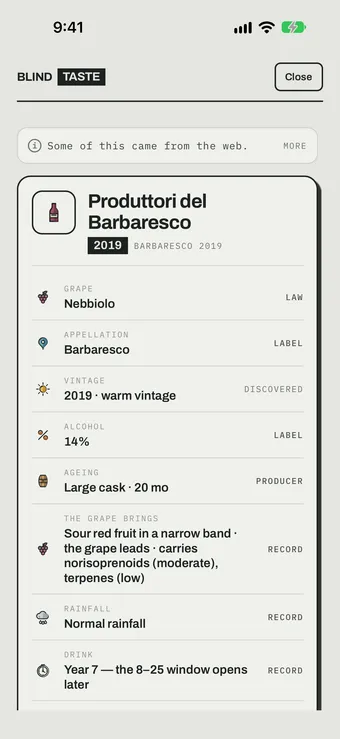
Every fact carries its source.
After the reveal, the bottle reads like an importer's technical sheet: grape, place, cellar work, the vintage's weather, legal yields and ageing, the drinking window.
Each row wears a tier that says where it came from: the appellation law, the label, the producer's own pages, a sourced look-up on the web, or the record. Facts never come from critics' notes. When the app doesn't know, it says which kind of not-knowing it is.
Tasted wrong, or deduced wrong?
The debrief names the kind of mistake, so you know what to practise.
Your reading and your call both line up with the key.
You misread an axis. Practise tasting.
You read the structure right and concluded wrong. Practise reasoning.
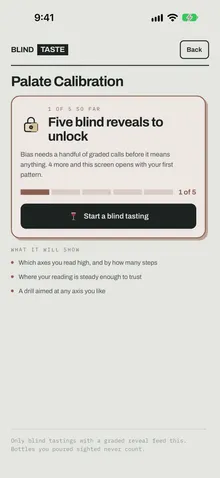
After five graded reveals, calibration shows your bias on each axis.
What it won't do
The sheet is free forever.
Tasting, history, saved views, your own sheets and calibration cost nothing. Reveals are the paid part, with five free to start. Pricing at launch.
Questions
Does the app tell me what I'm drinking while I taste?
No. It withholds help until you commit. The unaided call is the training.
Where do the facts come from?
Appellation law, producers' own pages, documented norms, and live web lookups marked as such. Every row shows its source. Critics' notes are never stored or shown.
Is this an AI wine app?
A model reads the label and fills gaps in the facts; it never grades. A rules engine builds the key and grades your sheet, and can explain every call in a sentence.
What if it can't identify my bottle?
It says so and spends nothing. An honest "could not identify" is the product working.
Does it rate wines?
No. No scores, no other people's opinions.
Can I use my own tasting system?
Yes. Build a sheet to mirror what you study. The built-in sheet uses our own wording.
What does it cost?
The sheet is free forever. Reveals are the paid part, with five free to start. Pricing at launch.
More help: Blind Taste support · what the app collects